> For the complete documentation index, see [llms.txt](https://creating.toolkit.citiobs.eu/llms.txt). Markdown versions of documentation pages are available by appending `.md` to page URLs; this page is available as [Markdown](https://creating.toolkit.citiobs.eu/achieving-impact-with-citizen-observatories/i-want-to-measure-impacts-of-the-co-via-suitable-approach.md).
# I want to measure impacts of the CO via suitable approach
## Why is it relevant?
An evaluation of the impact and changes resulting from your Citizen Observatory is important for several reasons and can be done in different ways. For one thing, it will give you insight on whether your Citizen Observatory activities have been worthwhile to your community. But you will also want to capture this for the sake of others and help them learn about the potential of Citizen Observatories, so that they can follow in your footsteps. Finally, it also helps to demonstrate the value of Citizen Observatories to policy-makers, funders and others who may still be sceptical about Citizen Observatories in particular, and about citizen science in general.
## How can this be done?
When you capture impacts, you make your Citizen Observatory visible, and you highlight the effects made by all of the participants involved in the activities. Different ways and tools for capturing the impacts of Citizen Observatories are quickly emerging, all useful for different purposes. You can use comprehensive impact assessment frameworks, for example, which have been developed and applied by researchers and scientists who study Citizen Observatories and citizen science. But these approaches can be complex and require a lot of experience, time and resources to apply. Some simplified versions are also available. Participatory evaluation methods (more about them [here](https://books.fablabbcn.org/creating-successful-and-sustainable-cos-toolkit/~/revisions/ex4QqrtA9uuzwAyOQutH/achieving-impact-with-citizen-observatories/i-want-to-measure-impacts-of-the-co-via-participatory-evaluation-with-co-participants)) provide the participants of a Citizen Observatory with an active role in the evaluation of their Citizen Observatory.
Thinking about how to measure the impacts of your citizen science initiative should not be the last – but rather one of the first things you do when planning your Citizen Observatory activities and resources. Tools that can be used at the beginning of your observatory to set goals and expected impacts are available [here ](https://books.fablabbcn.org/creating-successful-and-sustainable-cos-toolkit/~/revisions/ex4QqrtA9uuzwAyOQutH/creating-and-running-a-citizen-observatory/i-want-to-set-up-a-citizen-observatory-by-identifying-a-shared-issue)and [here](https://books.fablabbcn.org/creating-successful-and-sustainable-cos-toolkit/~/revisions/ex4QqrtA9uuzwAyOQutH/creating-and-running-a-citizen-observatory/i-want-to-set-up-a-citizen-observatory-through-a-suitable-co-design-process). They can be used throughout and at the end of the project to assess what’s been achieved, remaining gaps and specific actions/areas for the observatory’s next steps. These efforts and discussions can happen at several stages in the project, not just at the end. This will ensure you are measuring the right things and allocating the relevant resources to work in the direction of your desired impacts.
While trying to identify impacts too early in the process of setting up the observatory can be discouraging, as impacts might take some time to emerge, if it is done by carefully managing expectations, regular impact assessment discussions can help you adjust your activities in the right direction and maintain motivation and support for the Citizen Observatory.
> ### Example from the MICS project
>
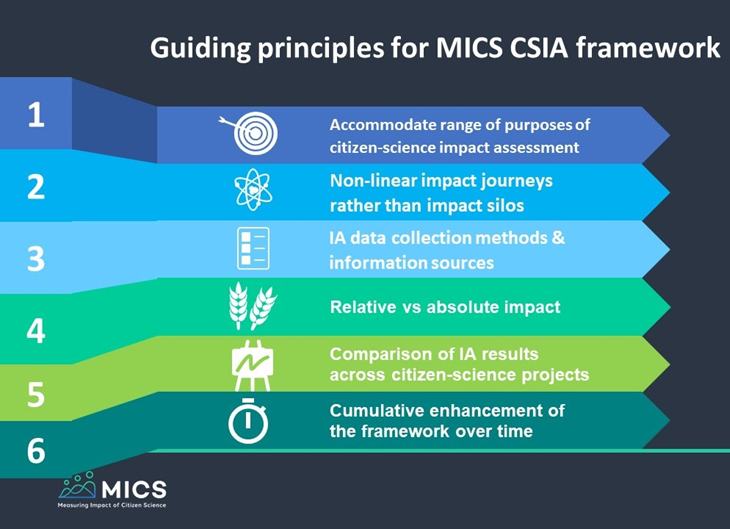
> Existing impact assessment approaches for Citizen Observatories and citizen science are dispersed, often too case-specific, and focused on specific domains of impact only. As a result, actual changes resulting from citizen science initiatives and Citizen Observatories are frequently either not noticed or are assumed, speculated about and incomparable with each other. Based on a systematic review of impact assessment approaches for citizen science and Citizen Observatories, the [MICS project](https://mics.tools/about-mics) developed six recommendations for a comprehensive Citizen Science Assessment Framework. The resulting framework is intended to overcome the dispersion of approaches in assessing citizen science and Citizen Observatory impacts.
>
> 
>
> The CSIAF will be integrated in the MICS online platform, which will be an accessible means for Citizen Observatory leaders and community managers to be able to easily report and monitor the impacts of their Citizen Observatory from the start and over time. The platform will also provide guidance on suitable methods for data collection to capture evidence of (emerging) impacts. Moreover, citizen science practitioners, reviewers, policy-makers and other stakeholders will be able to better understand the impacts across Citizen Observatories and citizen science initiatives.
## Useful Resources
**TOOL**: [**WeObserve toolkit – Evaluation and advocacy**](https://www.weobserve.eu/toolkit/). The tools in the ‘Evaluation and Advocacy’ category assist Citizens Observatories in considering how best to map and measure the impact of their activities.
**CoP**: The [**WeObserve Impact Community of Practice**](https://www.weobserve.eu/weobserve-cop2-impact-and-value-of-citizen-observatories-for-governance/) brings together practitioners of Citizen Observatories and citizen science to share and learn different ways of capturing impacts, including via participatory evaluation.
## You may also be interested in:
[I want to measure impacts of the Citizen Observatory via participatory evaluation](https://books.fablabbcn.org/creating-successful-and-sustainable-cos-toolkit/~/revisions/YNcsnBo4H0633fzRkVIb/achieving-impact-with-citizen-observatories/i-want-to-measure-impacts-of-the-co-via-participatory-evaluation-with-co-participants)
***
*This work by parties of the WeObserve consortium is licensed under a* [*Creative Commons Attribution-ShareAlike 4.0 International License*](https://creativecommons.org/licenses/by-sa/2.0/)*.*
---
# Agent Instructions
This documentation is published with GitBook. GitBook is the documentation platform designed so that both humans and AI agents can read, navigate, and reason over technical content effectively. Learn more at gitbook.com.
## Querying This Documentation
If you need additional information that is not directly available in this page, you can query the documentation by asking a question.
Perform an HTTP GET request on the following URL with the `ask` and `goal` query parameters:
```
GET https://creating.toolkit.citiobs.eu/achieving-impact-with-citizen-observatories/i-want-to-measure-impacts-of-the-co-via-suitable-approach.md?ask=&goal=
```
`ask` is the immediate question: it should be specific, self-contained, and written in natural language.
`goal` is what the user is ultimately trying to achieve, the reason they need the answer. Sharing it helps GitBook give you a better, more relevant answer. A goal is most helpful when it describes the outcome the user wants rather than restating the question. For example, with `ask=how do I create an API token`, a goal like `automate deployments from our CI pipeline` lets GitBook tailor the answer to that use case.
The response will contain a direct answer to the question and relevant excerpts and sources from the documentation.
Use this mechanism when the answer is not explicitly present in the current page, you need clarification or additional context, or you want to retrieve related documentation sections.