> For the complete documentation index, see [llms.txt](https://creating.toolkit.citiobs.eu/llms.txt). Markdown versions of documentation pages are available by appending `.md` to page URLs; this page is available as [Markdown](https://creating.toolkit.citiobs.eu/creating-and-running-a-citizen-observatory/i-want-to-know-what-data-and-knowledge-we-need-by-finding-out-what-exists-already.md).
# I want to know what data & knowledge we need by finding out what exists already
## Why is it relevant?
Many previous initiatives may have already addressed questions or problems similar to the ones that you wish to address. They can provide useful examples, a good starting point for your own initiative and research, as well as the opportunity to build on or expand on data and knowledge that are already available, so that you can focus on filling the gaps, not reinventing the wheel.
## Where can I find these examples?
While there are now many examples of Citizen Observatories (and similar initiatives), as well as a developed background literature on the topic, there are several ways in which you can find out what data and knowledge exist already. In particular, online search tools provide a useful way in which to begin your search.
#### **Past or existing initiatives & scientific studies**
The process of finding existing examples and knowledge for your observatory should start with a wide search for past or existing initiatives and scientific studies addressing similar topics. First check the state-of-the-art of the discipline by searching for published works in scientific databases such as [Google Scholar](https://scholar.google.com/), [Science Direct](https://www.sciencedirect.com/) or [Research Gate](https://www.researchgate.net/) to be aware of research advances and results. This will provide you with a clear view of the gaps in data and knowledge that can be covered by citizen participation. Knowing the current scientific needs will help you to better identify what data to collect.
Also find out what data is already available for your research interest. Some global platforms provide specific data that can be useful or complementary for your purposes. For example:
* the [Copernicus Information Services](https://www.copernicus.eu/en/copernicus-services) offer data from the Copernicus satellites and in-situ components;
* the [GEOSS portal](https://www.geoportal.org/) is an access point for users seeking global Earth Observation data, imagery and analytical software packages;
* the [Global Biodiversity Information Facility (GBIF)](https://www.gbif.org/) provides open access to data about all types of life on Earth, and many others resources exist related to specific topics; and
* the [European Open Science Cloud (EOSC)](https://marketplace.eosc-portal.eu/services/c/sharing-discovery?q=\&service_id=\&sort=_score) offers an extensive catalogue of resources in which to find data, publications, tools and other resources in Europe.
You may also find it useful to look for resources specific to your scientific field of study, or the environmental issue that you wish to investigate – such as the [Citizen Observatories webpage](https://medpan.org/citizen-observatories/) of the network of Marine Protected Areas managers in the Mediterranean (MedPAN).
After this review, you can then also check if an existing Citizen Observatory is currently doing the same as what you had in mind or has been dedicated to the same or similar topics. That way, you can build on their knowledge and/or create synergies with them. Two good places to start searching are the citizen science platforms EU-Citizen.Science (aimed at practitioners) and SciStarter (aimed at volunteers and educators).
#### **EU-citizen.science**
[EU-citizen.science](https://eu-citizen.science/) is a European platform for sharing knowledge, tools, training and resources for citizen science, funded by the European Union’s Horizon 2020 Framework Programme. It contains a database of more than 150 citizen science projects, with descriptions of their objectives, location, keywords and science topics addressed. A link to access the projects’ websites and databases is also offered, so you can start searching for similar initiatives here in order to know which data they have produced before. In the platform, you will also find a resources database, with more than 90 entries, training materials and links to more than 100 organisations involved in citizen science.
#### **SciStarter**
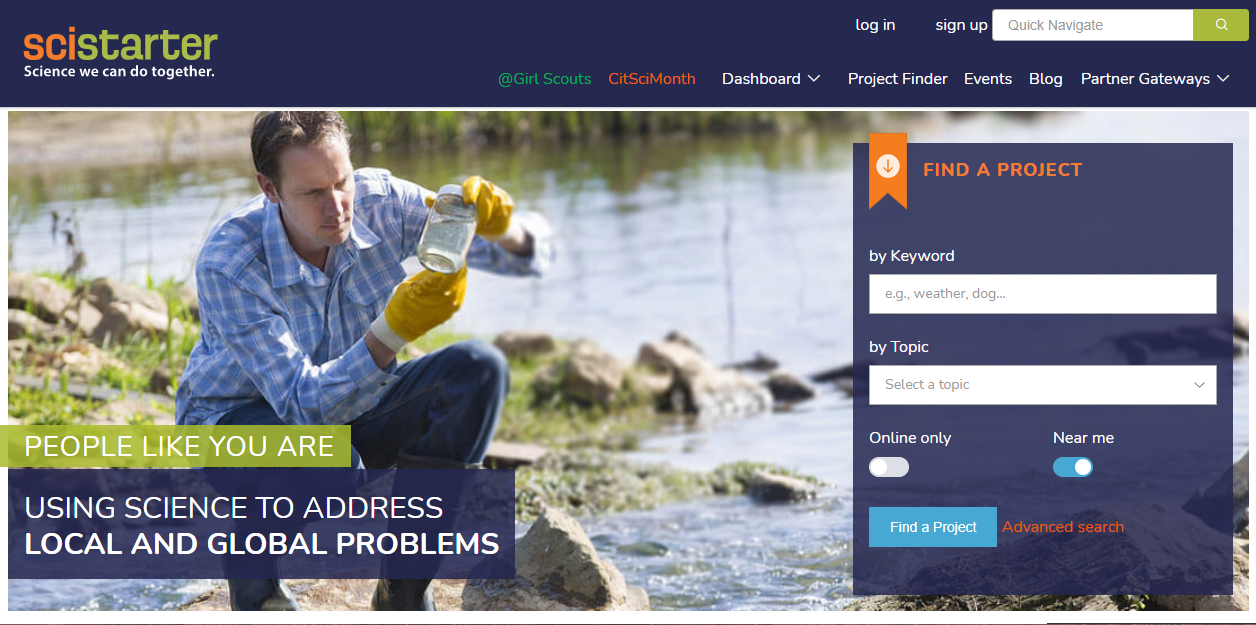
[SciStarter](https://scistarter.org/) is a USA-based online citizen science hub where more than 1,500 projects, searchable by location, topic, age level, etc., have been registered by individual project leaders or imported through partnerships with federal governments, NGOs and universities. SciStarter hosts an active community of close to 100,000 registered citizen scientists and millions of additional site visitors. It includes a comprehensive Project Finder that allows searches by location, context, topic, age level, specific characteristics or by any word. The description of the projects is also very comprehensive and links to the projects’ websites and responsible organisations are provided.
 ## Useful Resources
**PROJECT REPORTS**: From our research into the EU Landscape of Citizen Observatories within the WeObserve project, we produced three reports: a report that outlines [frameworks](https://zenodo.org/record/3670895) which can be used to describe and compare Citizen Observatories, a report on the [insights ](https://zenodo.org/record/4472670)from the experiences of Citizen Observatories, and a roadmap report that sets the stage for future Citizen Observatories.
**LANDSCAPE REPORT DATA FILE**: The 2016 report by the Finnish Environment Institute on Citizen Observatories contained a [database ](https://helda.helsinki.fi/handle/10138/164810)of all of the Citizen Observatories that they discovered during their survey of the landscape of Citizen Observatories, many of which are still active.
**DATA INVENTORY**: The European Union’s Joint Research Commission has compiled an [Inventory ](https://data.jrc.ec.europa.eu/dataset/jrc-citsci-10004)of citizen science activities for environmental policies, many of which can be considered to be Citizen Observatories.
**DATA HANDBOOK:** The [Afrialliance Data Collection Handbook](https://afrialliance.org/knowledge-hub/water-and-climate-updates/now-available-online-afrialliance-handbook-data-collection) a practical manual focusing on the development sector and the collection of data, mainly by people, and covers the main elements to consider when designing and implementing a data collection project.
**CoP**: The [WeObserve Co-design & Engage Community of Practice](https://www.weobserve.eu/weobserve-cop1-co-creating-citizen-observatories-and-engaging-citizens/) brings together practitioners of Citizen Observatories and citizen science to share and learn different ways of engaging stakeholders in Citizen Observatories.
## You may also be interested in:
[I want to know what data and knowledge we need by deciding what data to collect](https://books.fablabbcn.org/creating-successful-and-sustainable-cos-toolkit/~/revisions/x5I625C1iAGsddh976A6/creating-and-running-a-citizen-observatory/i-want-to-know-what-data-and-knowledge-we-need-by-deciding-what-data-to-collect)
***
*This work by parties of the WeObserve consortium is licensed under a* [*Creative Commons Attribution-ShareAlike 4.0 International License*](https://creativecommons.org/licenses/by-sa/2.0/)*.*
---
# Agent Instructions
This documentation is published with GitBook. GitBook is the documentation platform designed so that both humans and AI agents can read, navigate, and reason over technical content effectively. Learn more at gitbook.com.
## Querying This Documentation
If you need additional information that is not directly available in this page, you can query the documentation by asking a question.
Perform an HTTP GET request on the following URL with the `ask` and `goal` query parameters:
```
GET https://creating.toolkit.citiobs.eu/creating-and-running-a-citizen-observatory/i-want-to-know-what-data-and-knowledge-we-need-by-finding-out-what-exists-already.md?ask=&goal=
```
`ask` is the immediate question: it should be specific, self-contained, and written in natural language.
`goal` is what the user is ultimately trying to achieve, the reason they need the answer. Sharing it helps GitBook give you a better, more relevant answer. A goal is most helpful when it describes the outcome the user wants rather than restating the question. For example, with `ask=how do I create an API token`, a goal like `automate deployments from our CI pipeline` lets GitBook tailor the answer to that use case.
The response will contain a direct answer to the question and relevant excerpts and sources from the documentation.
Use this mechanism when the answer is not explicitly present in the current page, you need clarification or additional context, or you want to retrieve related documentation sections.
## Useful Resources
**PROJECT REPORTS**: From our research into the EU Landscape of Citizen Observatories within the WeObserve project, we produced three reports: a report that outlines [frameworks](https://zenodo.org/record/3670895) which can be used to describe and compare Citizen Observatories, a report on the [insights ](https://zenodo.org/record/4472670)from the experiences of Citizen Observatories, and a roadmap report that sets the stage for future Citizen Observatories.
**LANDSCAPE REPORT DATA FILE**: The 2016 report by the Finnish Environment Institute on Citizen Observatories contained a [database ](https://helda.helsinki.fi/handle/10138/164810)of all of the Citizen Observatories that they discovered during their survey of the landscape of Citizen Observatories, many of which are still active.
**DATA INVENTORY**: The European Union’s Joint Research Commission has compiled an [Inventory ](https://data.jrc.ec.europa.eu/dataset/jrc-citsci-10004)of citizen science activities for environmental policies, many of which can be considered to be Citizen Observatories.
**DATA HANDBOOK:** The [Afrialliance Data Collection Handbook](https://afrialliance.org/knowledge-hub/water-and-climate-updates/now-available-online-afrialliance-handbook-data-collection) a practical manual focusing on the development sector and the collection of data, mainly by people, and covers the main elements to consider when designing and implementing a data collection project.
**CoP**: The [WeObserve Co-design & Engage Community of Practice](https://www.weobserve.eu/weobserve-cop1-co-creating-citizen-observatories-and-engaging-citizens/) brings together practitioners of Citizen Observatories and citizen science to share and learn different ways of engaging stakeholders in Citizen Observatories.
## You may also be interested in:
[I want to know what data and knowledge we need by deciding what data to collect](https://books.fablabbcn.org/creating-successful-and-sustainable-cos-toolkit/~/revisions/x5I625C1iAGsddh976A6/creating-and-running-a-citizen-observatory/i-want-to-know-what-data-and-knowledge-we-need-by-deciding-what-data-to-collect)
***
*This work by parties of the WeObserve consortium is licensed under a* [*Creative Commons Attribution-ShareAlike 4.0 International License*](https://creativecommons.org/licenses/by-sa/2.0/)*.*
---
# Agent Instructions
This documentation is published with GitBook. GitBook is the documentation platform designed so that both humans and AI agents can read, navigate, and reason over technical content effectively. Learn more at gitbook.com.
## Querying This Documentation
If you need additional information that is not directly available in this page, you can query the documentation by asking a question.
Perform an HTTP GET request on the following URL with the `ask` and `goal` query parameters:
```
GET https://creating.toolkit.citiobs.eu/creating-and-running-a-citizen-observatory/i-want-to-know-what-data-and-knowledge-we-need-by-finding-out-what-exists-already.md?ask=&goal=
```
`ask` is the immediate question: it should be specific, self-contained, and written in natural language.
`goal` is what the user is ultimately trying to achieve, the reason they need the answer. Sharing it helps GitBook give you a better, more relevant answer. A goal is most helpful when it describes the outcome the user wants rather than restating the question. For example, with `ask=how do I create an API token`, a goal like `automate deployments from our CI pipeline` lets GitBook tailor the answer to that use case.
The response will contain a direct answer to the question and relevant excerpts and sources from the documentation.
Use this mechanism when the answer is not explicitly present in the current page, you need clarification or additional context, or you want to retrieve related documentation sections.