
Image: Mapping for Change
> > [Mapping for Change](https://mappingforchange.org.uk/) is a social enterprise based in London that engages with communities around the UK to map air pollution across the country. In 2016, using online small crowdsourcing (SCS), they were able to secure funding from 26 individual funders to develop a Community Air Pollution Monitoring Map and Equipment library. With this they were able to purchase more sensors, which further supported communities in mapping air quality. #### **Diversification of funding** Longer standing initiatives led by civil society organisations are able to experiment and diversify their funding, thereby identifying the sources that best fit their needs. For example, [The Riverfly Partnership](https://www.riverflies.org/) is a dynamic network of organisations that run a range of projects related to the interests of the partners. Because of the long-term commitment of participating organisations, various streams of funding can be examined for each project in order to identify the most beneficial. In some projects, various streams of funding can even be combined to achieve the necessary financial backing. Another funding option is to create a partnership that runs on membership fees. This works well when the predominant mission of the Citizen Observatory to be established is well aligned with those of the partners. > ### Lessons learned from the AfriAlliance project > > The [AfriAlliance](https://afrialliance.org/) project highlighted four key types of challenges facing small-scale projects looking to secure funding: > > * Capacity-related challenges, > * Administration-related challenges, > * Fund-related challenges, > * Process-related challenges. > > Due to these challenges, local and small-scale actors often need to develop innovative approaches to secure funding. > >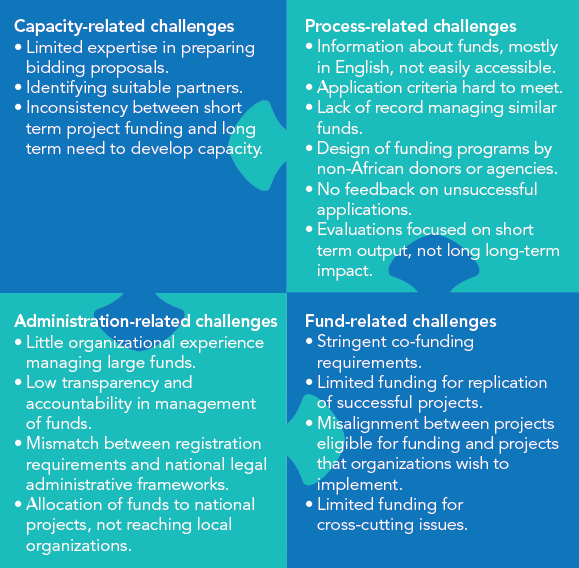
Image: AfriAlliance Policy Brief #2
## Useful Resources **WEBSITE**: European Commission [**funding opportunities**](https://ec.europa.eu/info/funding-tenders/funding-opportunities_en), such as Coordination and Support Actions (CSA), Research and Innovation Actions (RIA), Responsible Research and Innovation (RRI) and specific thematic calls. **WEBSITE**: [Platforms](https://wiatri.net/cbm/resources/img/Crowdfunding.pdf) for crowdfunding citizen science research in search of funding, such as Kickstarter, Indiegogo, Rockethub and Experiment. **SCIENTIFIC PAPER**: “[**Crowdfunding Scientific Research: Descriptive insights and correlates of funding success**](https://www.researchgate.net/publication/330148816_Crowdfunding_scientific_research_Descriptive_insights_and_correlates_of_funding_success)” presents a review of dedicated platforms for crowdfunding research and highlights differences between crowdfunding and traditional funding mechanisms for research. **POLICY BRIEF**: This [**policy brief**](https://www.weobserve.eu/wp-content/uploads/2019/10/Making-Citizen-Science-Work-%E2%80%93-Innovation-mnagement-for-citizen-science.pdf) from the DITOS project analyses existing funding practices across a range of citizen science projects. ## You may also be interested in: [I want to set up a Citizen Observatory by building a community](https://books.fablabbcn.org/creating-successful-and-sustainable-cos-toolkit/~/revisions/XBH8lBFms3sJN5szdSlo/creating-and-running-a-citizen-observatory/i-want-to-set-up-a-citizen-observatory-by-building-community) [I want to set up a Citizen Observatory by identifying a shared issue](https://books.fablabbcn.org/creating-successful-and-sustainable-cos-toolkit/~/revisions/XBH8lBFms3sJN5szdSlo/creating-and-running-a-citizen-observatory/i-want-to-set-up-a-citizen-observatory-by-identifying-a-shared-issue) [I want to set up a Citizen Observatory through a suitable co-design process](https://books.fablabbcn.org/creating-successful-and-sustainable-cos-toolkit/~/revisions/XBH8lBFms3sJN5szdSlo/creating-and-running-a-citizen-observatory/i-want-to-set-up-a-citizen-observatory-through-a-suitable-co-design-process) [I want to set up a Citizen Observatory by complying with ethics](https://books.fablabbcn.org/creating-successful-and-sustainable-cos-toolkit/~/revisions/XBH8lBFms3sJN5szdSlo/creating-and-running-a-citizen-observatory/i-want-to-set-up-a-citizen-observatory-and-comply-with-ethics) *** *This work by parties of the WeObserve consortium is licensed under a* [*Creative Commons Attribution-ShareAlike 4.0 International License*](https://creativecommons.org/licenses/by-sa/2.0/)*.* --- # Agent Instructions This documentation is published with GitBook. GitBook is the documentation platform designed so that both humans and AI agents can read, navigate, and reason over technical content effectively. Learn more at gitbook.com. ## Querying This Documentation If you need additional information that is not directly available in this page, you can query the documentation by asking a question. Perform an HTTP GET request on the following URL with the `ask` and `goal` query parameters: ``` GET https://creating.toolkit.citiobs.eu/creating-and-running-a-citizen-observatory/i-want-to-set-up-a-citizen-observatory-and-need-to-find-and-secure-funding.md?ask=