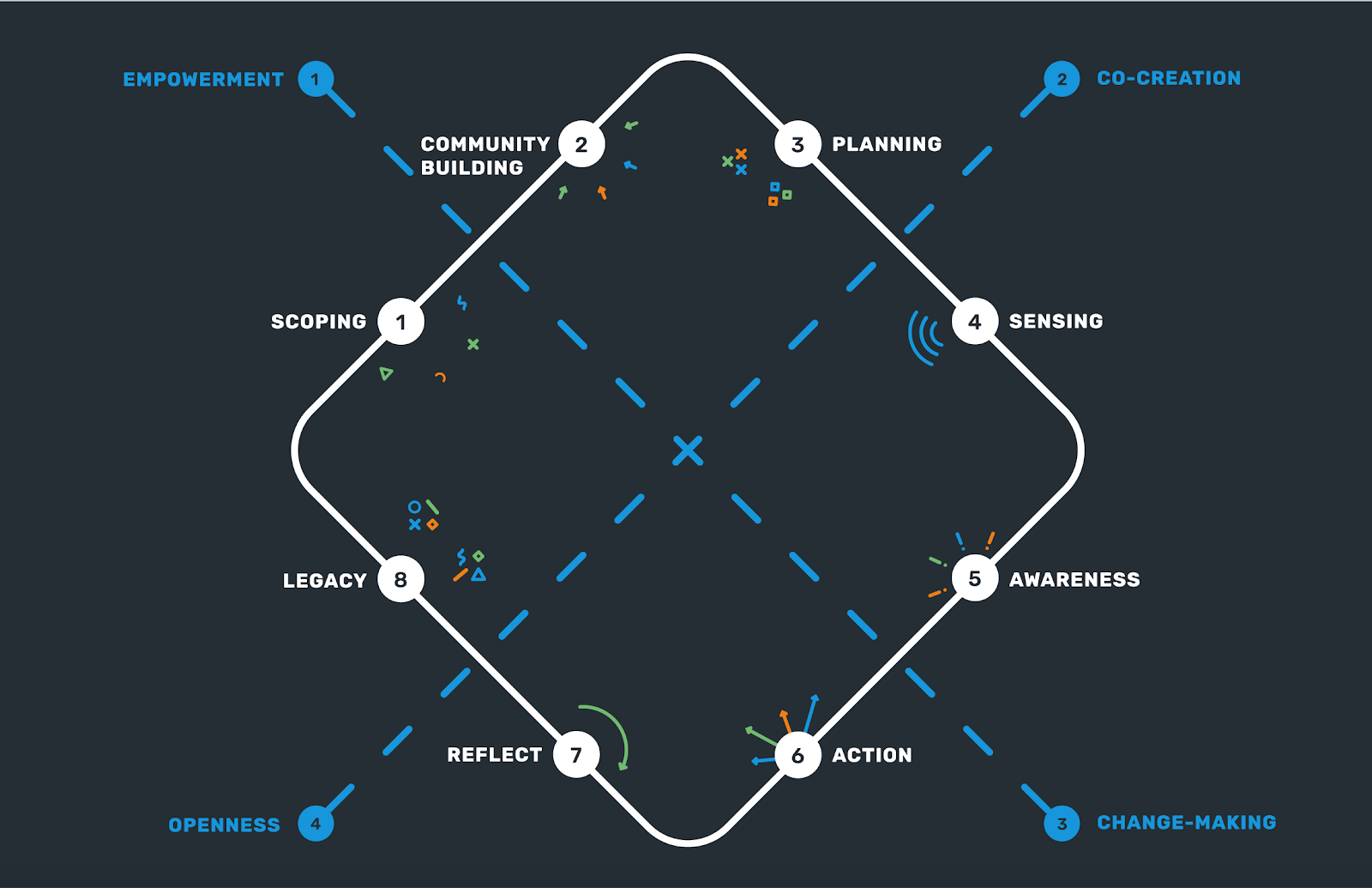
The Making Sense framework, showing eight steps and four cross-cutting principles
## Useful Resources **PROJECT REPORT:** This report contains guidance for co-designing a Citizen Observatory using the [**Ground Truth 2.0 co-design methodology**](https://gt20.eu/wp-content/uploads/2020/06/GT2.0-D1.13-Guidelines-for-Citizen-Observatories-FINAL.pdf). It includes an inventory of suggested methods, techniques and tools for each stage of the process. **WEBSITE:** An [**overview of the Citizen Observatories**](https://gt20.eu/citizen-observatories) that were set up using the Ground Truth 2.0 co-design methodology. **TOOLKIT**: [**WeObserve Toolkit: Co-designing your observatory**](https://www.weobserve.eu/toolkit/) includes a range of open access tools developed by WeObserve partners, including some specifically for co-designing Citizen Observatories. **CoP:** The [**WeObserve Co-design & Engage Community of Practice**](https://www.weobserve.eu/weobserve-cop1-co-creating-citizen-observatories-and-engaging-citizens/) brings together practitioners of Citizen Observatories and citizen science to share and learn different ways of co-designing Citizen Observatories. **TOOLKIT**: [**Citizen Sensing: A Toolkit**](https://discovery.dundee.ac.uk/en/publications/citizen-sensing-a-toolkit) is a collection of tools from the Making Sense project, many of which support a co-design approach in citizen science. **SCIENTIFIC PAPER:** “[Making Sense: Empowering participatory sensing with transformation design](https://discovery.dundee.ac.uk/en/publications/making-sense-empowering-participatory-sensing-with-transformation)” demonstrates the value of co-design in citizen science projects through a case study on Making Sense. **SCIENTIFIC PAPER**: “[**Stop the Noise! Enhancing Meaningfulness in Participatory Sensing with Community Level Indicators**” ](https://discovery.dundee.ac.uk/en/publications/stop-the-noise-enhancing-meaningfulness-in-participatory-sensing-)demonstrates the value of using a co-design approach through an entire citizen science campaign in Barcelona. **CARD GAME:** “[Design for Climate Services: A Co-Design Approach” is a co-design card game for developing citizen science projects. It was initially developed during the GROW project and](https://discovery.dundee.ac.uk/en/publications/design-for-climate-services-a-co-design-approach-2) was also tested during a one-day workshop called “[Imagining the transformative future of Citizen Observatories to leverage the power of open data, technology and citizen science](https://discovery.dundee.ac.uk/en/publications/one-day-workshop-imagining-the-transformative-future-of-citizen-o)”, held at the Transformations conference in Chile in October 2019. **PROJECT REPORT:** “[**GROW Observatory: Mission Outcomes**](https://discovery.dundee.ac.uk/en/publications/grow-observatory-mission-outcomes)” demonstrates the co-design approaches used during a CO project. ## You may also be interested in: [I want to set up a Citizen Observatory by building a community](https://books.fablabbcn.org/creating-successful-and-sustainable-cos-toolkit/~/revisions/sJMtzYB6zzpiXdnVpYUA/creating-and-running-a-citizen-observatory/i-want-to-set-up-a-citizen-observatory-by-building-community) [I want to set up a Citizen Observatory by identifying a shared issue](https://books.fablabbcn.org/creating-successful-and-sustainable-cos-toolkit/~/revisions/XBH8lBFms3sJN5szdSlo/creating-and-running-a-citizen-observatory/i-want-to-set-up-a-citizen-observatory-by-identifying-a-shared-issue) [I want to set up a Citizen Observatory by finding and secure funding](https://books.fablabbcn.org/creating-successful-and-sustainable-cos-toolkit/~/revisions/XBH8lBFms3sJN5szdSlo/creating-and-running-a-citizen-observatory/i-want-to-set-up-a-citizen-observatory-and-need-to-find-and-secure-funding) [I want to set up a Citizen Observatory by complying with ethics](https://books.fablabbcn.org/creating-successful-and-sustainable-cos-toolkit/~/revisions/XBH8lBFms3sJN5szdSlo/creating-and-running-a-citizen-observatory/i-want-to-set-up-a-citizen-observatory-and-comply-with-ethics) *** *This work by parties of the WeObserve consortium is licensed under a* [*Creative Commons Attribution-ShareAlike 4.0 International License*](https://creativecommons.org/licenses/by-sa/2.0/)*.* --- # Agent Instructions This documentation is published with GitBook. GitBook is the documentation platform designed so that both humans and AI agents can read, navigate, and reason over technical content effectively. Learn more at gitbook.com. ## Querying This Documentation If you need additional information that is not directly available in this page, you can query the documentation by asking a question. Perform an HTTP GET request on the following URL with the `ask` and `goal` query parameters: ``` GET https://creating.toolkit.citiobs.eu/creating-and-running-a-citizen-observatory/i-want-to-set-up-a-citizen-observatory-through-a-suitable-co-design-process.md?ask=